Sound Therapy and Sound Healing
in Geneva, London and Online
One-to-one sessions, sound baths, and professional training
When you can’t fully relax, your mind won’t stop, or you feel it may be time to listen differently
At Swiss Sound Therapy, sound therapy and sound healing are approached as structured forms of facilitation.
We begin with the person or group, the purpose of the session and what may be needed - not with the instrument.
Sound, rhythm, voice, breath, silence and other practices are then selected and adapted according to their function within the experience. Depending on the context, this may include supporting nervous system regulation, embodied awareness, attention, activation, expression, integration or inner clarity.
This is not sound used as distraction or performance, and it is not based on fixed claims about what a particular instrument should do.
Our work includes one-to-one sound therapy sessions, group sound baths, and professional sound therapy training in Geneva, London and online.
You may recognise yourself here
You do not need to know exactly what you need before you begin.
Many people arrive here because something no longer feels easy to manage on their own.
They often say things like:
- I can’t relax
- My mind doesn’t stop
- I feel tense all the time
- I feel disconnected from myself
- I can’t switch off
- Meditation isn’t working for me
- I know something needs to change
- I want to work with sound, but I want a serious framework
Behind these phrases, there is often something simple:
too much inner noise, not enough space to listen clearly.
Swiss Sound Therapy begins there.
Not by asking you to do more,
but by creating conditions in which the body can settle, attention can stabilise, and something more coherent can begin to emerge.
What Swiss Sound Therapy is
Swiss Sound Therapy is:
- a structured sound healing practice
- a professional training school
- a facilitation method
- and a platform for exploring how sound supports regulation, perception, presence, and clarity
At the centre of the work is a simple experiential sequence:
Person first. Purpose second. Method third.
We understand the starting point, clarify the intended direction, identify what function may be useful, select an appropriate method, then observe and adapt.
This same logic runs through:
- one-to-one sessions
- group sound baths
- professional training
The role of sound is not to impose an effect or interpretation.
Its role is to support conditions in which people may begin to:
- settle more deeply
- perceive internal signals more clearly
- listen with more depth
- and reconnect with a more stable inner orientation
Trusted by clients and students in Geneva, London, and internationally
Why sound?
Because there are moments when thinking more is no longer the answer.
When the body remains tense, when the mind keeps circling, and when life is being lived mainly through analysis, many people intuitively feel that they need another way in.
Sound can become that doorway.
Not because it solves everything, but because it can help support:
- a slowing of internal pace
- a clearer sense of the body
- reduced mental interference
- deeper listening
- and a more direct experience of what is actually happening inside
Sound does not demand performance.
It creates the conditions for presence.
Three ways to begin
1. One-to-one sound therapy sessions and sound healing sessions
For when you need something more personal, focused, and tailored
One-to-one sessions are designed for people experiencing:
- stress
- fatigue
- mental overload
- emotional saturation
- physical tension
- transition
- a need for clarity
- difficulty settling or switching off
These sessions may include sound, voice, rhythm, breath, listening, and personalised tools to support regulation and daily integration.
2. Group sound baths in London and Geneva
For when you want to start simply, in a shared and well-held space
Sound baths offer a collective experience of slowing down, returning to the body, and stepping out of constant mental activity.
They are open to everyone and require no prior experience.
At Swiss Sound Therapy, sound baths are not treated as background relaxation or aesthetic performance. They are structured as spaces of regulation, listening, and embodied presence.
3. Professional sound therapy and sound healing training
For when you want to learn how to work with sound in a serious and structured way
Our trainings are designed for people who want to:
- begin a new professional direction
- integrate sound into an existing practice
- guide sound baths more professionally
- deepen their relationship to sound
- or develop a more embodied and responsible facilitation practice
We welcome:
- people in career transition
- yoga teachers
- therapists and coaches
- bodyworkers
- musicians and artists
- and people already working with sound intuitively who now want more structure
A grounded and structured approach
Many sound healing approaches rely heavily on abstract ideas, symbolic systems, or language that feels vague or exaggerated.
For many people, that creates distance rather than trust.
Swiss Sound Therapy was developed differently.
The work is:
- grounded
- experiential
- clear
- professional
- embodied
- structured
It does not ask you to believe in anything.
It asks you to observe what becomes possible when attention is supported through sound, rhythm, silence, and listening.
We work with:
- embodied listening
- sound, breath and attention
- vocal work
- rhythm and pacing
- structured facilitation
- practical integration tools
You are not treated as a passive recipient.
You remain an active participant in the process, with space to observe, feel, and integrate your own experience.
What makes this work different
Swiss Sound Therapy does not begin by asking:
Which instrument should we use?
It begins by asking:
What is happening, what is the purpose of the session, and what may genuinely support the person or group?
A gong, singing bowl, drum, voice, breathing practice or silence does not have one fixed therapeutic function.
The practitioner learns to select and adapt methods according to the context, the intended direction and what is observed during the experience.
This function-led approach is at the heart of our sound therapy sessions, therapeutic sound baths and professional practitioner training.
Sound remains central – but listening, observation and appropriate facilitation come first.
About the founder
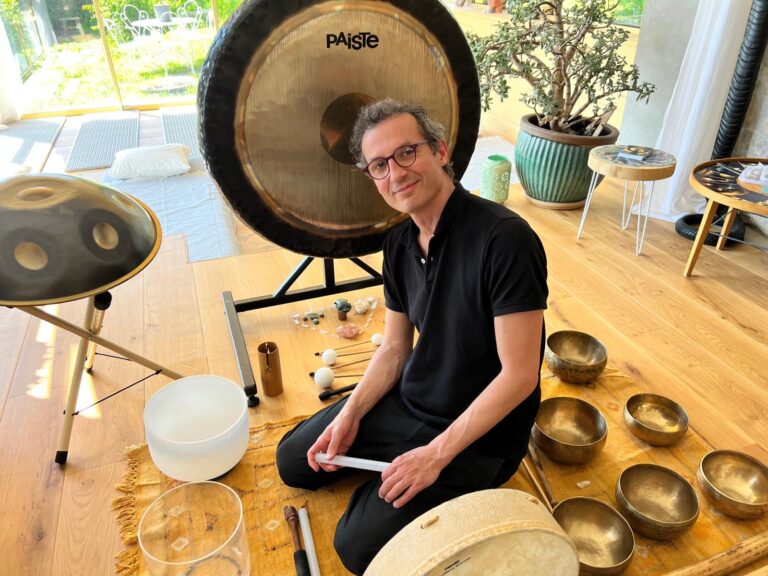
Othman Haddad – Founder & Methodology Director
Othman Haddad founded Swiss Sound Therapy after an earlier career in systems engineering, software testing and programme management, followed by more than a decade of full-time therapeutic practice.
Since 2012, he has worked with individuals, groups, organisations and practitioners internationally, and has trained sound therapy practitioners since 2017.
His background in analysing complex systems strongly influenced the development of SST: understand what is happening, identify the relevant priorities, choose an appropriate intervention, observe the response and adapt.
Today, he develops the SST methodology alongside selected client work, professional training, group sound therapy and multidisciplinary collaborations.
Upcoming events in London and Geneva
You may not need to do more. You may simply need a different way to listen.
Sometimes change does not begin with a new strategy.
Sometimes it begins when the system settles enough for something more honest, more subtle, and more essential to become audible.
That is what Swiss Sound Therapy is here to support.
Through sound.
Through the body.
Through listening.
And through a structured, human, and professional approach.
Whether you are looking for sound therapy in London, a sound bath in Geneva, or a professional sound therapy training, you can begin from where you are.
Frequently Asked Questions
Sound therapy is a structured use of sound, vibration and listening to support different aspects of human experience, including attention, regulation, embodied awareness, expression and integration. At Swiss Sound Therapy, the purpose and the person come before the choice of instrument or technique.
Sound therapy focuses on structured, experience-based approaches to regulation and perception, while sound healing is a broader term often used for relaxation or energetic practices.
No prior experience is required. Sound baths are designed to be accessible to most people. Certain health situations may require additional guidance before attending, so please check the relevant session information or contact us if you are unsure.
Sound therapy is a broad field, and not all approaches are grounded in the same level of rigour.
At Swiss Sound Therapy, our work is informed by areas such as:
- nervous system regulation
- auditory perception and attention
- the physiological effects of sound and rhythm on the body
- and emerging research on voice analysis and sound-based interventions
There is a growing body of research suggesting that sound and music can influence:
- perceived stress and anxiety
- attention and cognitive load
- emotional regulation
- and, in some cases, sleep quality
However, it is important to remain precise.
This does not mean that specific frequencies “heal” conditions or that sound can replace medical care.
Our approach does not rely on fixed interpretations or claims about the body.
Instead, it is based on a simple and observable principle:
Instead, we work from a practical principle: the effect of sound depends on the person, the context and how it is used.
Sound may be used as a structured support for:
- nervous system regulation
- attention and engagement
- embodied awareness
- activation or rest
- expression
- integration
The practitioner observes the response and adapts the approach rather than assuming that a particular sound will always create a particular outcome.
⚠️ Sound Therapy and Sound Healing Do Not Replace Medical Care
At Swiss Sound Therapy, our sound therapy sessions, sound baths, and professional trainings are offered within a framework of well-being, nervous system regulation, embodied presence, and the development of deep listening.
They are not a substitute for medical, psychological, or psychiatric treatment or supervision.
If you are experiencing a health condition, receiving treatment, or living with persistent physical or emotional symptoms, we strongly recommend consulting a qualified healthcare professional.
At Swiss Sound Therapy, sound therapy and sound healing are offered as complementary, non-invasive, and respectful approaches that may support regulation, awareness, and overall balance – but they do not diagnose, treat, or cure medical conditions.