
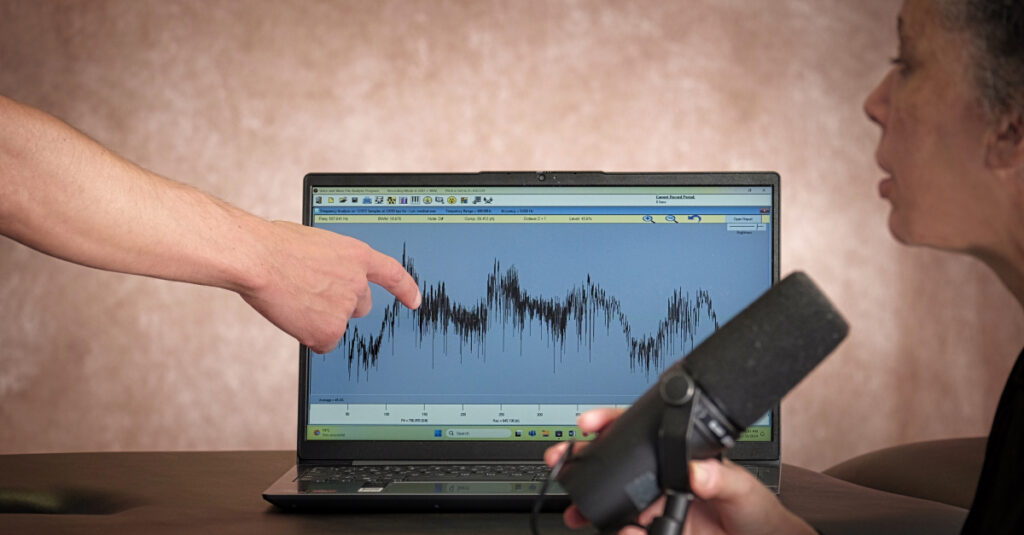
There are times when a person understands very well what they are going through, yet still does not feel better. The mind keeps moving, the body stays tense, and despite every effort to calm down, nothing truly settles. Many people describe this with very simple phrases: I think too much, I can’t relax, I feel disconnected from myself, my mind never stops. In this context, BioTuning is not presented as a diagnosis or a promise of healing. It is an approach that uses voice and sound as points of entry for better self-listening, support for regulation, and the recovery of greater inner clarity. Research on acoustic voice analysis and speech features suggests that some vocal parameters can vary with stress, negative emotion, and cognitive load, while still requiring careful interpretation and strong contextual framing.
When the mind keeps going even when everything seems fine
There are periods when, outwardly, nothing looks alarming, and yet inwardly something does not follow. The body remains slightly contracted, the breath does not fully drop, and the mind continues as if it still has something to hold together. Many people arrive with this same feeling: they are not necessarily in an obvious crisis, but they cannot truly let go. They say they think too much, struggle to slow down, and sometimes feel strangely distant from themselves.
This kind of experience is often approached through thinking alone. People try to understand, analyse, and organise, as if the right explanation will finally allow the system to calm down. But very often, understanding is not enough. A person may know their patterns clearly, and yet their inner state changes very little. This is precisely where the voice becomes interesting: it offers another point of entry, one that is more direct, more embodied, and closer to the way the system is actually organising itself in the present moment.
Why the voice can become a useful point of entry
The voice is not simply a way of speaking. It is shaped by breath, muscular tone, bodily coordination, emotional state, effort, and attention. When a person speaks, something of their present organisation passes into the sound itself. This is not an absolute truth about the person, and certainly not a diagnosis. It is a set of descriptive cues that may help orient listening.
Current research in acoustic voice analysis supports this cautious position. Voice analysis has increasingly moved toward digital signal processing and computational tools within broader multidimensional assessment frameworks, while research on speech and stress suggests that prosodic, spectral, and voice-quality features can correlate with negative emotion, stress, and cognitive load. At the same time, researchers also stress inconsistency across studies and the need for careful interpretation.
That is where BioTuning finds its place. Not as a machine that explains a person, but as a way of listening more finely to what seems highly mobilised, what seems less available, and what might support more stability.
What BioTuning is — and what it is not
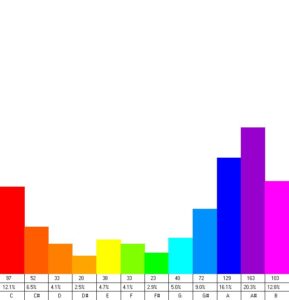
BioTuning is an approach that uses voice recording, frequency analysis, and sound delivery as supports for orientation. Technically, the software records, calculates, displays, and generates sounds. It can produce histograms, frequency representations, and formulas. But it does not know what a person feels, it does not decide anything, and it does not explain anything on its own.
This distinction is essential. A graph is not truth. A formula is not a solution. Data is not a diagnosis. In this approach, the software remains a computational tool, while meaning can only emerge in the meeting between a clear frame, the practitioner’s listening, and above all the person’s own reported experience. That fits well with the broader direction of acoustic voice analysis research, which recognises technical progress while also emphasising the limits of interpretation.
In other words, BioTuning is not an authority over the human being. It is a technical support embedded in human facilitation. The practitioner does not tell the person who they are. The work helps clarify what may need more support, regulation, or presence.
What a session looks like
A session begins with conversation. This first exchange helps clarify what the person is going through in the present moment: overload, fatigue, agitation, confusion, difficulty slowing down, disconnection, persistent tension, or something else. A voice recording is then made using a natural speaking voice. The aim is not to speak well or produce a “good” voice, but to allow a real voice to appear in simple speech.
The software then analyses the vocal signal and displays certain distributions. This moment can help orient attention toward zones of mobilisation, compensation, or lower availability. But again, nothing is imposed. What matters is how these technical markers meet what the person themselves recognises in their actual experience.
In some cases, specific sounds or frequencies are then tested or offered within a carefully governed frame, with constant adjustment and regular return to what is actually being felt. The aim is not to produce a dramatic reaction. It is to observe what helps, what tires, what allows the system to settle a little more, and what does not fit. The client remains the central reference point.
Why sound can sometimes help calm an over-mobilised system
When a person says I think too much or I can’t relax, what they are describing is not only a problem of ideas. Very often, the body also remains mobilised. The breath does not fully expand, a background tension persists, and attention remains on alert. In that state, asking the mind to “let go” is not always enough.
This is where sound can become interesting, not as a miracle solution, but as a sensory support. Sound can help structure attention, slow internal pacing, and make the body easier to perceive. Research on auditory attention shows that sound actively shapes how attention is oriented and processed, and recent reviews suggest that music-based interventions may support anxiety reduction in some contexts.
That does not prove that a specific frequency “corrects” a state. But it does support the idea that carefully framed sound work can sometimes offer the system a route other than thought alone.
An approach based on listening, not over-interpretation
One of the risks in the field of voice and sound is the temptation to do too much. To explain the person too quickly. To assume that a missing note must mean something precise, that a peak on a graph tells a life story, or that a bodily reaction proves a hidden truth.
In the approach I develop, this drift is deliberately avoided. The voice is not there to lock someone into a reading. It is there to open a finer form of listening. Data is only useful when it stays connected to lived experience, context, and a clear professional posture. That is also consistent with current research on voice analysis: the technology is evolving quickly, but interpretation still requires rigour, caution, and framework.
So the question is not: What does this graph say about you?
The more useful question is: What in what we observe here might help you feel more clearly what is happening in you, and return to greater stability?
BioTuning as a doorway to more regulation and clarity
When it is used with precision and modesty, BioTuning can become a valuable tool. Not because it replaces speech or felt experience, but because it can sometimes make certain dynamics easier to perceive. It can support a form of inner orientation, help distinguish what is highly mobilised from what feels less available, and open the possibility of sound work that supports greater presence.
In that sense, BioTuning does not come to “fix” the person. It comes to support listening. And when listening becomes clearer, a great deal can already begin to change. A person starts to notice what is actually exhausting them. They begin to perceive what requires more support. Some of the confusion softens. And sometimes, it is precisely this kind of simple clarity that opens the possibility of a more accurate movement forward.
Conclusion
f you feel that you think too much, cannot fully relax, or feel cut off from yourself, it does not necessarily mean you lack willpower or need to analyse more. It may simply be that your system needs a different kind of listening.
BioTuning offers one possible path for that: using the voice as an orienting support, sound as a possible anchor, and the relationship itself as a frame for returning to greater presence, regulation, and clarity. No imposed diagnosis. No exaggerated promise. Just one central question:
What might help you, today, to feel more clearly what is happening inside you?
If you would like to explore this approach, you can book an individual session in Geneva or get in touch to see whether this work fits what you are currently going through.
What exactly is BioTuning?
BioTuning is an approach that uses voice, frequency analysis, and sound as supports for listening, orientation, and regulation. It is not a medical diagnosis.
Can BioTuning help if I think too much?
Some people come precisely because they feel they think too much or cannot slow down. The aim is not to “switch off the mind”, but to help the system settle enough for self-listening to become more accessible.
Does voice analysis tell the truth about a person?
No. It offers descriptive reference points at a given moment. Whatever is observed must always be checked against the person’s actual experience and context.
Is BioTuning a therapy?
In this approach, BioTuning is presented as a sound- and voice-based facilitation practice, not as a medical treatment or diagnostic act.
Are the frequencies heard or felt?
Depending on the setup, some frequencies are heard more clearly and others are felt more through the body. What matters is not a dramatic effect, but how the system actually responds.
Scientific references
- Fantini M. et al. (2024). The Rapidly Evolving Scenario of Acoustic Voice Analysis in Medicine.
- Schewski L. et al. (2025). Measuring negative emotions and stress through acoustic correlates in speech: a systematic review.
- Razzaghipour A. et al. (2024). A Review of Auditory Attention: Neural Mechanisms, Theories, and Influencing Factors.
- de Witte M. et al. (2025). Music therapy for the treatment of anxiety: a systematic review and meta-analysis.
- Zhao N. et al. (2024). A systematic review and meta-analysis of music interventions and sleep quality.